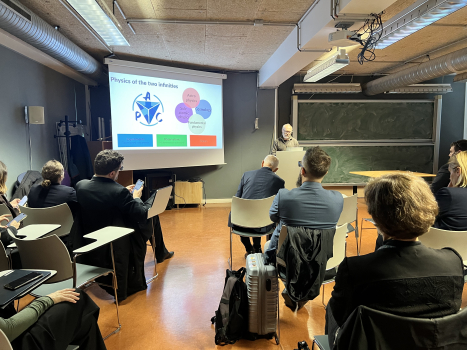
On December 3, 2025, the Astroparticle & Cosmology Laboratory welcomed a Polish delegation led by Prof. Andrzej Szeptycki, Undersecretary of State at the Polish Ministry of Science and Higher Education. Organized by the CNRS's Europe and International Department, this visit was part of the 8th Franco-Polish Forum for Science and Innovation. It comes at a pivotal moment: the signing of an agreement between the CNRS and the Polish Academy of Sciences, aimed at strengthening the partnership between the APC and the future International Institute for Particle Astrophysics (AstroCeNT). Prof. Leszek Roszkowski, future director of AstroCeNT, was present and emphasized the importance of the Franco-Polish strategic partnership in the field of fundamental research.
The French-Polish delegation, whose visit was organized by Louis Avigdor, Deputy Director of the European Research and International Cooperation Department at CNRS, was accompanied by Mr. Matthieu Osmont, Scientific Cooperation Attaché at the French Embassy in Warsaw at the Ministry for Europe and Foreign Affairs (MEAE), Ms. Fanny Dufétel-Viste, Project Manager in charge of bilateral relations with Northern Europe, and Ms. Gabrielle Lenormand (International Project Manager - Strategic Dialogues) from the Ministry of Higher Education, Research, and Space (MESRE).
Ms. Miryana Hémadi, Vice President for Human Resources and Finance, and Valérie Serre, Vice-Dean of International Relations at the Faculty of Sciences, welcomed the delegation on behalf of Université Paris Cité, while Louis Avigdor and Nicolas Leroy, Deputy Scientific Director of “Astroparticles and Cosmology” at CNRS Nuclear and Particles (IN2P3), a key institute in the development of this partnership, spoke on behalf of the CNRS, emphasizing its commitment and that of its structures to this Franco-Polish collaboration.
Seven years of strategic partnership
At the heart of this meeting lies a scientific collaboration established more than seven years ago, inspired by the vision and model of the APC. AstroCeNT, created in 2018 as an autonomous department of CAMK PAN, has reached a new milestone with the award of significant European funding under Horizon Europe WIDERA Teaming for Excellence.
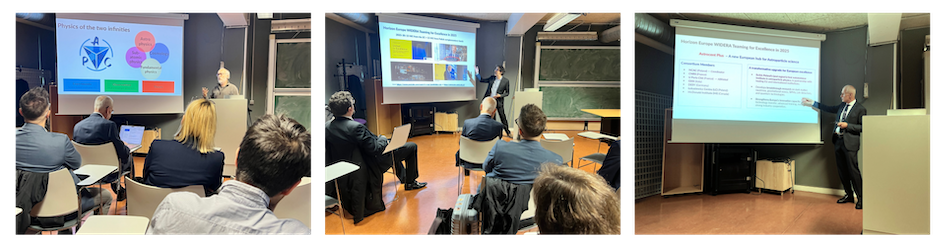
Representing the laboratory's management, Éric Chassande-Mottin and Davide Franco presented the laboratory's main areas of research to the Polish guests, covering topics such as cosmology, the study of dark matter and dark energy, gravitational wave astronomy, multi-messenger astrophysics, etc.
This was followed by a series of discussions on European strategy and the development of cutting-edge technologies and instruments for astrophysics. The delegation was able to observe the APC's expertise up close during a guided tour of its facilities, including the low-noise lab and its use for the Athena mission, and the photodetection lab for experiments such as KM3NeT. The subject of the future third-generation terrestrial gravitational wave detector, the Einstein telescope, was also discussed. A specific session focused on the scientific awareness and education projects of the Cosmos, Science and Society Center.
Beyond research: mediation and technical expertise
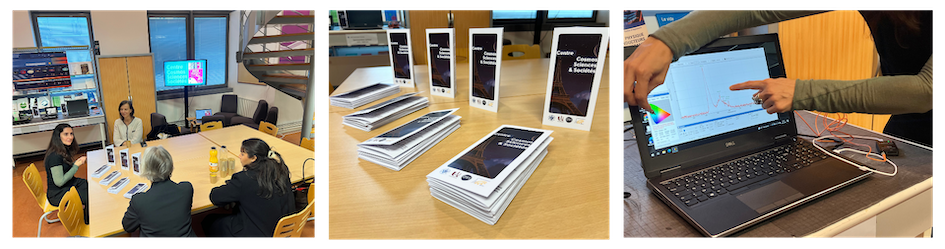
The visit also highlighted the importance that France and Poland attach to opening up science to society. The team at the Cosmos, Science and Society Center had the opportunity to detail its scientific outreach activities. A portable scientific demonstration, notably the optical spectrometer, illustrated the center's commitment to “building bridges” between science and the general public.
Astrocent+: a major European transformation
The future of this cooperation is now defined by the AstroCeNT+ project, labeled “Horizon Europe WIDERA Teaming for Excellence.” This program represents a decisive step forward for European excellence in astroparticle physics. AstroCeNT+ aims to create Poland's first autonomous institute dedicated to astroparticle physics, in partnership with leading international institutions such as the CNRS and Paris Cité University.
The APC will play an essential role in this project, notably by ensuring the transfer of expertise, providing administrative management support, training young researchers (theses, internships, summer schools), and helping to define a strategic vision. This meeting symbolizes a shared desire to promote science, innovation, and scientific mediation.
As emphasized in the conclusion of the meeting at the APC: “Long live our partnership with AstroCeNT!”
Further information and contacts
- AstroCent website.
- AstroCent contacts: Marta Borowiec.
- APC contacts: Julie Epas.
- Contact Center Cosmos, Science and Society.