
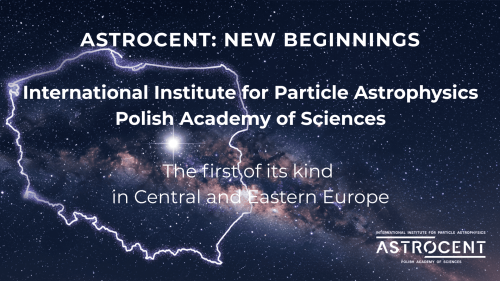
On February 17, 2025, the Polish Academy of Sciences (Polska Akademia Nauk - PAN) officially established the International Institute for Particle Astrophysics, which operates under the name Astrocent. Based in Warsaw, it is the first institute in Central and Eastern Europe entirely dedicated to particle astrophysics. The APC Laboratory, a partner of Astrocent, will play an important role in this project, whose development is supported by €30 million in European and national funding.
Astrocent's mission combines cutting-edge fundamental research with the development of technologies that accelerate experimental progress and create opportunities for practical implementation.
Its research explores the “hidden universe,” from dark matter to gravitational waves and neutrinos, while its technology program focuses on ultra-low-noise detection, photonics, sensors, and data systems. These technological capabilities can be translated into practical applications in medical imaging, environmental monitoring, and critical infrastructure.
Prof. Leszek Roszkowski, director of Astrocent, points out: "In particle astrophysics not only bold theoretical ideas but also beyond-the-state-of-the-art technological inventions are the sine qua non of achieving experimental breakthroughs and making discoveries happen. At Astrocent the emphasis on novel technologies will remain as strong as on frontline science. We hope that our inventions and potential industrial applications will be of interest to modern industry. But also, that, at the same time, this technology transfer will provide the new institute with additional funds."
A proven centre of excellence
The new institute grew out of Astrocent: Particle Astrophysics Science and Technology Centre, founded on July 1, 2018, as a department of the Nicolaus Copernicus Astronomical Center of the Polish Academy of Sciences. It was created as part of the International Research Agendas program of the Foundation for Polish Science. From the outset, the aim was to create a center of excellence in Poland combining fundamental research and the development of advanced detection technologies.
In just a few years, Astrocent has formed six research groups and a dedicated administrative team, established a fully equipped electronics laboratory and clean room infrastructure, and assembled an international staff. Throughout the project, 68 scientists from 19 countries across six continents worked at the center.
Astrocent researchers have published more than 150 scientific articles and developed technologies ranging from autonomous seismic and infrasound sensors to new wavelength conversion materials and liquid argon PET concepts for medical imaging.
The transformation into a new institute of the Polish Academy of Sciences was made possible thanks to a budget of €30 million: €15 million from the Horizon Europe Teaming for Excellence Astrocent Plus (end of 2024), plus €7 million from the Ministry of Science and Higher Education and €8 million from the Foundation for Polish Science.
Strategic international partnerships
Astrocent plays an active role in major international collaborations: DarkSide-20k and DEAP-3600 (dark matter research), Advanced Virgo and Einstein Telescope (gravitational waves), Hyper-Kamiokande and KM3NeT (neutrinos).
The institute has established a strategic partnership with the Astroparticle and Cosmology Laboratory (APC) in Paris, as well as collaborations with research groups from numerous institutions: INFN and Gran Sasso Science Institute (Italy), DESY (Germany), McDonald Institute (Canada), CERN (Switzerland), and many others.
As an international institute of the Polish Academy of Sciences, Astrocent will feature both on the national roadmap for research infrastructure and in the European research landscape as a reliable partner. Its role is to strengthen Poland's contribution to major international experiments in particle astrophysics, to develop technologies with an impact beyond fundamental science, and to train the next generation of researchers and engineers.
The institute was established by a decision of the President of the Polish Academy of Sciences (Resolution No. 6/2026 dated 17.02.2026). Prof. Marek Konarzewski serves as President of PAN (term 2023–2026).
Find out more
- Discover Astrocent's new website.
- Read the article: “Astrocent becomes a new international institute of the Polish Academy of Sciences”.
AstroCeNT communications contacts:
- Yuliya Hoika: yhoika@Astrocent.edu.pl
- Magda Jakubiak: mjakubiak@Astrocent.edu.pl