
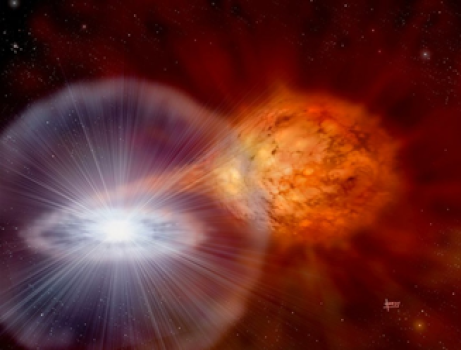
Shortly after the start of its scientific operations, the SVOM space mission demonstrated its full potential by detecting a spectacular phenomenon: a thermonuclear X-ray burst from the celestial source 4U 0614+091. This observation marks an important milestone for the mission, showing its ability to study not only distant gamma-ray bursts, but also violent phenomena occurring within our own Galaxy.
4U 0614+091 is a binary system located in the Milky Way in the Orion constellation about ten thousand light-years from Earth. It consists of a neutron star, an extremely dense object formed from the explosion of a massive star, and a companion star. This system is very compact, meaning the two stars are extremely close to each other. Under the influence of the neutron star’s extraordinarily intense gravitational field, matter from the companion star is gradually stripped away and accumulates on the surface of the neutron star. When this material becomes sufficiently hot and dense, it suddenly “ignites,” triggering a thermonuclear explosion observable as an intense burst of X-rays lasting several tens of seconds.
APC designed and built the coded mask of the ECLAIRs instrument. In addition, the laboratory is responsible for developing the ground-based data analysis pipeline, which enabled the detection presented in the recently published article. The APC SVOM team also oversees the mission’s Observatory Science program, dedicated to scientific observations and analyses beyond gamma-ray burst observations, as well as the management of the Target of Opportunity (ToO) observation program.