

In a paper to be published in Reviews of Modern Physics, a team of researchers from the APC, IRFU, and IPAG provides an overview of our current understanding of the center of our galaxy, based on X-ray and gamma-ray observations. This work draws on 25 years of research and a dozen theses devoted to the detailed analysis of observations from the XMM-Newton, Chandra, and Integral space missions, as well as those from ground-based observatories such as H.E.S.S.
This synthesis focuses on describing the central 600 parsecs of the Milky Way, a region known as the “Central Molecular Zone” (CMZ). This zone, dense with stars, interstellar matter, non-thermal filaments, supernova remnants, and other objects, and crisscrossed by magnetic fields, is the site of extreme and unique phenomena in the galaxy, resulting from interactions between its various components.
At the heart of the CMZ lies the supermassive black hole closest to Earth (4 million solar masses), associated with the compact radio source Sagittarius A* (Sgr A*). Since its discovery in 1974, this object has been the subject of frequent observations across all wavelengths.
As early as the 1990s, teams at the IRFU had demonstrated, using Sigma/Granat (1), that this black hole—although surrounded by a significant amount of matter and therefore capable of producing powerful high-energy emissions—exhibited remarkably low activity for an object of this mass. This finding led to the launch of extensive study programs beginning in the 2000s, utilizing the new large X-ray and gamma-ray observatories.
These Galactic Center observation programs (1, 2), many of which were led by teams from the APC and IRFU in collaboration with international partners and with support from CNES, have yielded major results. Among these:
- The persistent X-ray emission (2–10 keV) from Sgr A* and its erratic daily X-ray (and infrared) bursts (3).
- Stable central emission in hard X-rays (>20 keV), initially attributed to Sgr A*, but ultimately associated with a pulsar nebula and a population of X-ray binary systems (1).
- Echoes of X-ray (particularly in the neutral iron line at 6.4 keV) and hard X-ray light, reflected by the molecular clouds of the CMZ. These echoes reveal past outbursts of Sgr A* (less than 1,000 years old), with luminosities a million times greater than its current level (4).
- Lobes and chimneys of hot gas extending up to 150 pc on either side of the galactic plane, indicating even more powerful and ancient activity. These structures could be linked to the formation of the vast gamma-ray (GeV) and X-ray emission bubbles observed by the Fermi and eROSITA satellites, which extend up to 10 kpc into the galactic halo (2, 5).
A central source of TeV gamma-ray emission consistent with Sgr A*, though its definitive attribution to the black hole remains uncertain, as well as diffuse emission at the same energies, correlated with interstellar matter. The latter reveals the presence of a powerful central cosmic-ray accelerator (6).
This review presents all of these high-energy results and phenomena, placing them within the broader context of knowledge about the Galactic Center and comparing them to observations at longer wavelengths (radio and infrared).
By offering an overview based on a substantial body of observations, this synthesis constitutes a major assessment that will guide future studies. It should also help shape future observation programs, particularly with new generations of instruments such as CTAO for gamma rays and New-Athena for X-rays.
See also the CNRS Nuclear and Particles news: https://www.in2p3.cnrs.fr/fr/cnrsinfo/une-synthese-des-connaissances-sur-le-coeur-mysterieux-de-la-voie-lactee
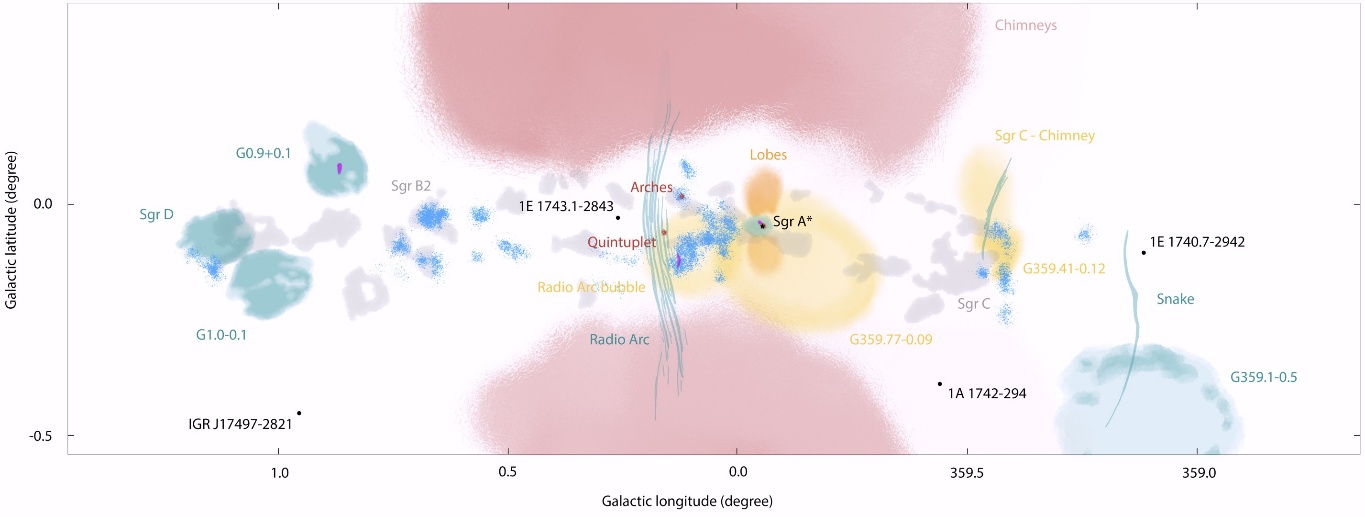
Mapping of high-energy sources and structures in the Central Molecular Zone [Fig 25 of the article, credits : Maïca Clavel]
Previous highlights (with references to publications and other related links):
https://irfu.cea.fr/dap/le-trou-noir-central-de-notre-galaxie/
https://www.esa.int/Science_Exploration/Space_Science/The_tumultuous_heart_of_our_Galaxy
https://irfu.cea.fr/dap/2003/01/sursaut-au-centre-de-la-galaxie/
http://www.nasa.gov/mission_pages/chandra/news/sagittariusA-black-hole.html
https://www.in2p3.cnrs.fr/fr/cnrsinfo/des-cheminees-rayons-x-geantes-au-centre-la-voie-lactee
L'experience H.E.S.S. decouvre un accelerateur cosmique en pleine action au centre de la Voie Lactee
Rayonnement cosmique : H.E.S.S. dévoile le premier PeVatron hadronique jamais observé
Contacts
APC : Andrea Goldwurm (aussi IRFU, andrea.goldwurm@cea.fr), Régis Terrier (rterrier@apc.in2p3.fr) et Stefano Gabici (gabici@apc.in2p3.fr)
IPAG : Maïca Clavel (maica.clavel@univ-grenoble-alpes.fr)
Publication
High Energy Emission from the Galactic Center, A. Goldwurm, M. Clavel, S. Gabici, R. Terrier, 2026, Reviews of Modern Physics, Vol. 98, Issue 2, in press, https://doi.org/10.1103/9nww-fclb
Pre-print: https://ui.adsabs.harvard.edu/abs/2026arXiv260214148G/abstract