

The APC Laboratory warmly congratulates Professor Francis Halzen (University of Wisconsin–Madison), recipient of the 2026 Nobel Prize in Physics for “his decisive contributions to the IceCube Neutrino Observatory and to the discovery of high-energy astrophysical neutrinos.”
The award recognizes a scientific and technological journey spanning more than three decades, which led to the emergence of an entirely new field of research: neutrino astronomy.
A pioneer of neutrino astronomy
Neutrinos are among the most elusive particles in nature. Yet they provide a unique way to investigate the most energetic environments in the Universe. Unlike light or charged cosmic particles, neutrinos can travel vast cosmic distances almost unaffected, carrying direct information about their sources.
The concept of using large transparent volumes to detect neutrinos dates back to the 1960s. In the late 1980s, Francis Halzen became one of the driving forces behind an ambitious idea: transforming the deep Antarctic ice into a gigantic neutrino detector.
Under his leadership, the AMANDA prototype was successfully deployed at the South Pole in the 1990s, paving the way for IceCube, a cubic-kilometre-scale neutrino observatory completed in 2010. In 2013, IceCube reported the first observation of a diffuse flux of high-energy cosmic neutrinos, marking the birth of high-energy neutrino astronomy.
A few years later, IceCube identified the blazar TXS 0506+056 as a likely source of astrophysical neutrinos. For the first time, a neutrino signal was associated with electromagnetic observations ranging from radio waves to gamma rays. This milestone became one of the earliest and most compelling demonstrations of modern multi-messenger astronomy.
ANTARES: the Mediterranean contribution
While IceCube was being developed at the South Pole, European researchers pursued the construction of underwater neutrino telescopes in the Mediterranean Sea. The ANTARES detector, deployed off the coast of Toulon between 2006 and 2008, demonstrated the long-term feasibility of deep-sea neutrino detection and highlighted the excellent optical properties of seawater.
APC played a major role in the construction, operation and scientific exploitation of ANTARES. The laboratory contributed significantly to searches for Galactic and extragalactic neutrino sources, as well as to pioneering joint analyses combining neutrino and gravitational-wave observations in collaboration with the Virgo and LIGO experiments.
Although ANTARES alone did not achieve a definitive detection of cosmic neutrinos, its results were combined with IceCube data in several joint studies that helped constrain the origin of high-energy astrophysical neutrinos and complement IceCube’s discoveries.
KM3NeT: the next generation
Today, the legacy of ANTARES continues through KM3NeT, the next-generation European neutrino observatory currently being deployed off the coasts of France and Sicily.
Its two detectors, ORCA and ARCA, pursue complementary scientific goals. ORCA focuses on the fundamental properties of atmospheric neutrinos, while ARCA is designed to identify and study the sources of high-energy cosmic neutrinos.
APC remains deeply involved in the project and is notably responsible for the development of the laser beacon systems used for detector time calibration.
The first scientific results have already demonstrated the extraordinary potential of the observatory. In February 2025, the KM3NeT Collaboration reported in Nature the detection of KM3-230213A, a cosmic neutrino with an estimated energy of about 220 PeV, making it the highest-energy neutrino ever observed.
This exceptional event showcases KM3NeT’s ability to explore a previously inaccessible region of the neutrino spectrum. Its origin remains unknown, while ARCA continues systematic searches for neutrino sources across the southern sky.
A Nobel Prize looking to the future
By honouring Francis Halzen, the 2026 Nobel Prize celebrates not only a groundbreaking discovery but also the creation of a completely new way of observing the Universe.
From the Antarctic ice of IceCube to the depths of the Mediterranean Sea where KM3NeT is taking shape, neutrino astronomy is entering a new era. Building on the foundations laid by Francis Halzen, the next generation of detectors promises many more discoveries in the years ahead.
APC is proud to contribute to this international scientific endeavour and to the future of neutrino astronomy.
References:
- KM3NeT Collaboration, Observation of an ultra-high-energy cosmic neutrino with KM3NeT, Nature 638, 376–382 (2025).
- KM3NeT Collaboration, Search for an all-sky and a Galactic Ridge diffuse neutrino emission with the first 2 years of KM3NeT/ARCA data, arXiv:2608.06163 (2026).
- KM3NeT Collaboration, KM3NeT/ARCA stacking search for high-energy neutrino point sources, arXiv:2609.03609 (2026).
- KM3NeT Collaboration, Optimizing the potential of KM3NeT in detecting core-collapse supernovae, JCAP 04 (2026) 038.
- En savoir plus sur les Nobels de physique : https://www.nobelprize.org/prizes/physics/
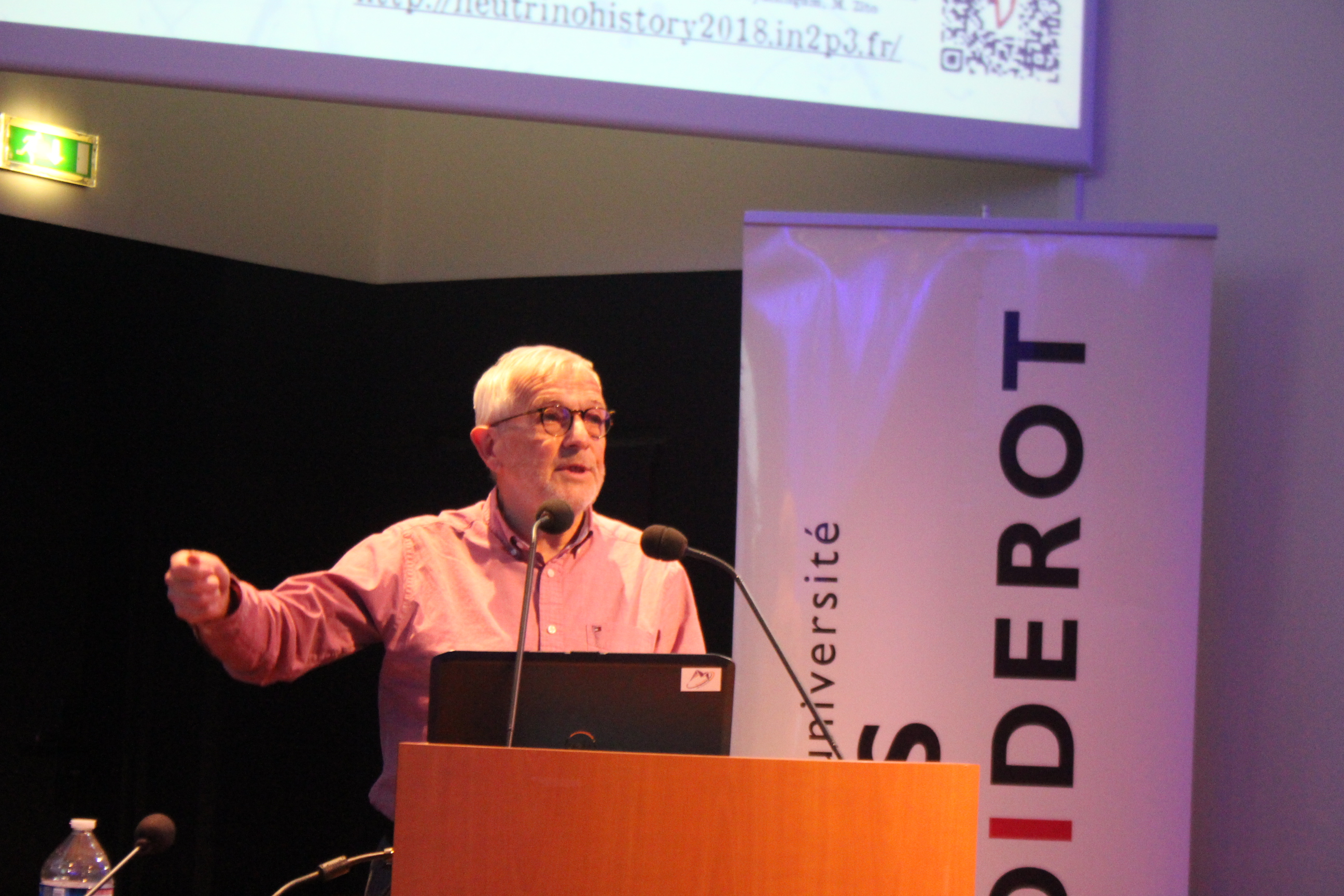
Professor Francis Halzen at the International Conference on the History of the Neutrino organized by APC in September 2018