A la une
|
APC Laboratoy Launches Its LinkedIn Page! | We are pleased to announce that the AstroParticle and Cosmology Laboratory is now officially on LinkedIn. This is a new way to stay connected with our research areas and showcase the scientific richness and excellence of our work. Follow us to help grow our community! |
|
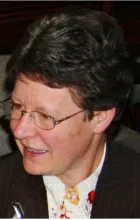
!! CANCELLED!! Prof. Jocelyn Bell Burnell (University of Oxford) at the APC laboratory | The seminar scheduled for tomorrow has been cancelled due to unforeseen circumstances. We apologize for any inconvenience and will provide an update regarding a possible rescheduling as soon as it becomes available. |
|
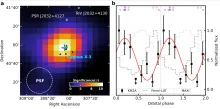
Cygnus X-3 Revealed as the First PeV Gamma-Ray Source by LHAASO | This discovery establishes the unusual binary system Cygnus X-3, located in the constellation Cygnus, as the highest-energy gamma-ray source known to date. LHAASO detected gamma-ray emission above 1 PeV with a statistical significance of 6.4 sigma. The highest-energy photon ever detected at Earth, with an energy of 3.7 PeV, originated from this source. The temporal variability and spectral properties measured by LHAASO provide strong evidence that Cygnus X-3 accelerates protons to energies of at least 30 PeV. These energies substantially exceed current theoretical expectations for Galactic particle accelerators. |

|
The laboratory is adopting a new logo | To mark the laboratory’s 20th anniversary, a reflection on renewing its visual identity was initiated. During the 2022 Biennial, it was decided to organize an internal competition to design a new logo. After an open vote involving the entire laboratory, the winning design—created by Alexandra Claraz—was selected. This logo embodies the laboratory’s research themes: the APC acronym extends into a primary line that strikes a particle or pixel, generating star-shaped fragments. Though these elements appear scattered, they form a harmonious ensemble evoking the cosmos. |
|
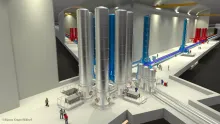
Einstein Telescope: ET-COMPASS gets the green light from the European Commission | On May 1, 2026, the European Commission approved ET-COMPASS, a Horizon Europe project with a budget of €1.5 million to support the Einstein Telescope as it moves into its implementation phase. Astrocent, a partner of the APC Laboratory, will lead the project’s international strategic communications. |
|
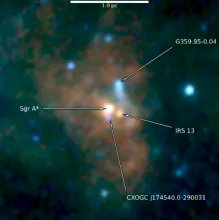
A summary of what we know about the mysterious center of the Milky Way | An article published in the prestigious Reviews of Modern Physics by a team from the APC Laboratory and collaborators summarizes current knowledge about the mysterious core of the Milky Way |
|
The Cosmos, Science, and Society Center launched its new science outreach website on astrophysics | In 2025, the Paris Center for Cosmological Physics (PCCP) became the Cosmos, Science, and Society Center (CSS). This name change is accompanied by a new logo and a new website. This evolution reaffirms the center’s core mission: a science outreach organization affiliated with the APC laboratory that works to build bridges between fundamental research in astrophysics and civil society. Discover their new website and their initiatives. |
|
Astrocent becomes the new international institute of the Polish Academy of Sciences | On February 17, 2025, the Polish Academy of Sciences officially established the International Institute for Particle Astrophysics, which operates under the name Astrocent. Based in Warsaw, it is the first institute in Central and Eastern Europe entirely dedicated to particle astrophysics. The APC Laboratory, a partner of Astrocent, will play an important role in this project, whose development is supported by €30 million in European and national funding. |
|
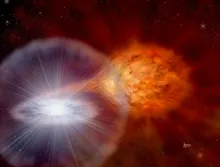
Svom Observes a Thermonuclear Explosion on a Neutron Star | Shortly after the start of its scientific operations, the SVOM space mission demonstrated its full potential by detecting a spectacular phenomenon: a thermonuclear X-ray burst from the celestial source 4U 0614+091. This observation marks an important milestone for the mission, showing its ability to study not only distant gamma-ray bursts, but also violent phenomena occurring within our own Galaxy. |
|
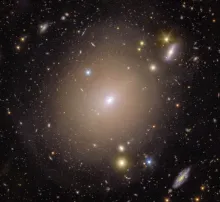
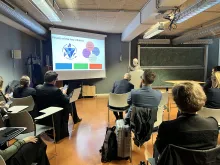
Theses 2026: discover the topics proposed by the APC | The Astroparticle and Cosmology Laboratory (APC) is opening its doors to future doctoral students. Thesis topics for 2026, led by the laboratory's research teams, are now available here and cover a wide range of topics related to the physics of the two infinities: high-energy astrophysics, cosmology, particle physics, gravitational waves, and theoretical physics. Interested candidates are invited to contact the person listed for each proposal. |
|
The Astroparticle & Cosmology Laboratory welcomes a Franco-Polish ministerial delegation | On December 3, 2025, the Astroparticle & Cosmology Laboratory welcomed a Polish delegation led by Prof. Andrzej Szeptycki, Undersecretary of State at the Polish Ministry of Science and Higher Education. This visit was part of the 8th Franco-Polish Forum for Science and Innovation. It comes at a pivotal moment: the signing of an agreement between the CNRS and the Polish Academy of Sciences, aimed at strengthening the partnership between the APC and the future International Institute for Particle Astrophysics (AstroCeNT). |

|
In Memory -- George Fitzgerald Smoot, III | The APC Laboratory mourns the loss of George Smoot, who passed away unexpectedly at his home in Paris. George Smoot was one of the pioneers of observations of the cosmic microwave background (CMB), which revolutionized our understanding of the cosmos and placed cosmology on a firm experimental footing. (Credits photo: Peter Badge/Lindau Nobel Laureate Meetings) |
|
APC physicists among winners of prestigious Breakthrough Prize in Fundamental Physics | Scientists from APC are among the researchers worldwide honored with the 2025 Breakthrough Prize in Fundamental Physics, awarded to the ATLAS Collaboration at CERN's Large Hadron Collider (LHC) alongside its sister experiments ALICE, CMS and LHCb |
|
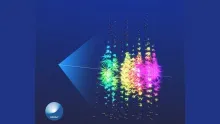
KM3NeT observes an ultra-high-energy cosmic neutrino | In February 2023, the KM3NeT experiment detected a very high-energy event, KM3-230213A, which was identified as a muon of approximately 120 Petaelectronvolts. |
|
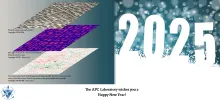
Best wishes 2025 | |

|
ACME kick-off, an EU-funded project built by and for the astroparticle and the astronomy communities | On the 16th and 17th of September was held in Paris the kick-off meeting for the Astrophysics Centre for Multimessenger studies in Europe – ACME. |
|
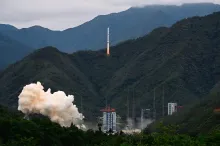
The SVOM mission was successfully launched! | The SVOM satellite, the fruit of collaboration between the French space agency (CNES), the Chinese space agency (CNSA) and the Chinese Academy of Sciences (CAS), was successfully launched on Saturday June 22 from the Xichang base in China. |
|
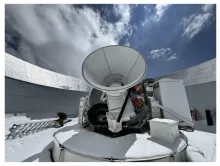
Simons Observatory Begins Hunt for Echoes of the Big Bang in Universe’s Oldest Light | One of the small-aperture telescopes at the Simons Observatory. Brian Keating/UC San Diego |
|
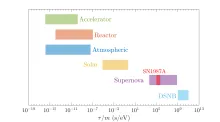
A novel bound on neutrino non-radiative decay from SN1987A | Pilar Iváñez-Ballesteros (PhD student) and Maria Cristina Volpe (APC Theory group) have published an article in the review Physics Letters B presenting the very first likelihood analysis of the 24 neutrino events from the SN1987A including the possibility that neutrinos can decay non-radiatively. |
|
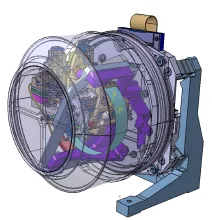
Successful integration of the Farside Seismic Suite at JPL! |
The most sensitive instrument ever built to measure far side moonquakes and meteorite impacts on planets other than Earth is preparing.
|

|
Einstein Probe opens its wide eyes to the X-ray sky | The first images captured by the innovative mission were presented at the 7th workshop of the Einstein Probe consortium in Beijing. They illustrate the satellite’s full potential and show that its novel optics, which mimic a lobster’s eyes, are ready to monitor the X-ray sky. |
|
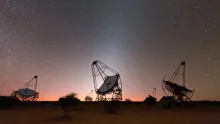
H.E.S.S. provides new data on the strange galactic microquasar SS 433 | The H.E.S.S. observatory in Namibia detected very high energy gamma rays coming from the plasma beams ("jets") of the microquasar SS 433, and located the exact location in them of one of the most efficient particle accelerators in the world. galaxy. |

|
Delivery of the Warm Front-End Electronics Demonstrator Model | View of the WFEE demonstration model. ©Laboratoire APC |
|
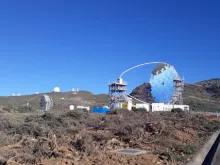
A journey to CTA northern site |
Dans les Iles Canaries de La Palma (Espagne), Cédric Champion, du service Electronique du laboratoire APC, assisté à distance par Michael Punch (physicien à APC), participe à la campagne d'intégration du prototype Large-Sized Telescope (LST) avec le Cherenkov Telescope Array Observatory (CTAO) Array Control and Data Acquisition System (ACADA).
|

|
The H.E.S.S. observatory detects the most energetic photons ever from a pulsar |
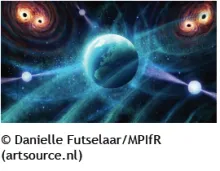
Artist's impression of the Vela pulsar, in the centre, and its magnetosphere, whose edge is marked by the bright circle. The blue tracks travelling outwards represent the paths of accelerated particles. These produce gamma radiation along the arms of a rotating spiral by colliding with infrared photons emitted in the magnetosphere (in red). © Science Communication Lab for DESY Scientists discover the highest energy gamma rays ever from a pulsar |
|
Pulsars open up a new window for gravitational wave observations |
On June 29, 2023, as part of a worldwide network dedicated to pulsar observation, a European consortium published a series of results in the journal Astronomy and Astrophysics, based on data collected over the last quarter-century by six of the world's most sensitive radio telescopes. |

|
The Laboratory is saddened at the passing of Nick Kaiser (1954-2023). |
The life of Nick Kaiser was full of interesting adventures of all sorts beyond the contributions to astrophysics for which he is best known. He was an accomplished marathon and ultramarathon runner, an avid hiker, and always up for adventures of all sorts. Nick never finished high school on account of some chemistry experiments not fully appreciated by those in charge. Nevertheless, he made it to the University of Cambridge, where he received a PhD under Martin Rees. Kaiser went on to make numerous important contributions to cosmology. |

|
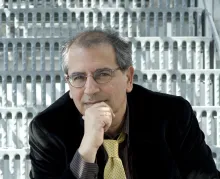
Wanda Diaz-Merced, the astronomer who listens to the stars | Wanda Diaz-Merced in the spotlight in June. |
|
Death of Stavros Katsanevas | The APC laboratory is deeply saddened by the death of Stavros Katsanevas, which occurred on November 27, 2022. |
|
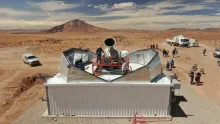
QUBIC Observatory inaugurated in Argentina | QUBIC Observatory: Aerial view during the inauguration Credit: MINCyT On 23 November the QUBIC Observatory was inaugurated with great success. |
|
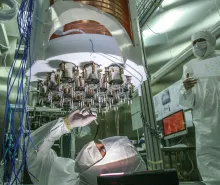
World's best limits for the search of light dark matter candidates with the DarkSide-50 experiment | The DarkSide detector. © Collaboration Darkside |

|
A French seismometer on board an upcoming US lunar mission | Illustration of the Draper lunar lander that will land on the moon in 2025. |
|
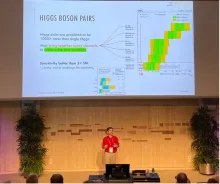
The Higgs boson Turns Ten | |
|
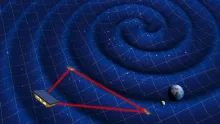
LISA mission enters final design phase | LISA has passed a feasibility review and is officially entering the preliminary design phase. |
|
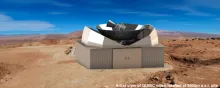
QUBIC: Exploring the Primordial Universe with QUBIC, the Q&U Bolometric Interferometer for Cosmology | Today eight articles prepared by the QUBIC collaboration will appear on a special issue of the “Journal of Cosmology and Astroparticle Physics”. |

|
The realization of the Qubic detectors in videos | The detectors of the QUBIC telescope presented in the video magazine Le blob. |

|
APC in solidarity with Ukraine | The APC laboratory relays messages of solidarity towards Ukraine of Université de Paris Cité and CNRS, with a special thought for the Ukrainian members of the laboratory and their families. |
|
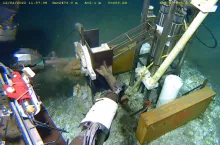
The ANTARES adventure | Mid-February, 2022, the first deep sea neutrino telescope, ANTARES, was powered down for the last time. |
|
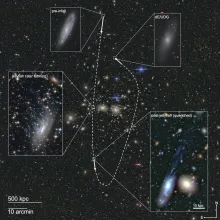
How ultra diffuse galaxies form | Publication in Nature Astronomy of the work of two PhD students of the APC Cosmology group |
|
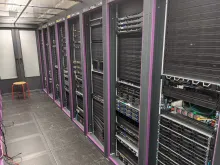
Inauguration of the DANTE supercomputer | DANTE's IT servers. @APC |
|
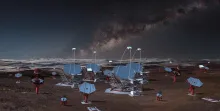
Gammapy chosen as the official Science Tools for CTA | The APC laboratory in France and the MPIK in Germany are the main architects. |
|
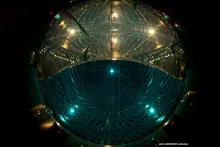
Award of the Giuseppe and Vanna Cocconi prize for an outstanding contribution to Particle Astrophysics and Cosmology to Borexino | For the groundbreaking observation of solar neutrinos from the pp chain and CNO cycle |
|
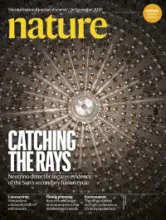
BOREXINO ACHIEVES THE FIRST EXPERIMENTAL TEST OF HOW MASSIVE STARS SHINE |
The Borexino scientific collaboration, an experiment at the Gran Sasso National Laboratories, publishes today, November 25th, 2020, in Nature the announcement of the first ever detection of neutrinos produced in the Sun by the CNO cycle (carbon-nitrogen-oxygen). It is an experimental result of historical value, which completes a chapter of physics that started in the 1930 decade of the last century. |
|
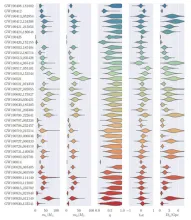
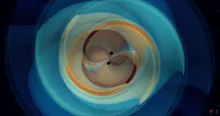
Publication by Virgo and LIGO of the GWTC-2 catalog containing 39 detections | |
|
Virgo and LIGO unveil new and unexpected black hole populations | Virgo and LIGO have announced the detection of an extraordinarily massive merging binary system |
|
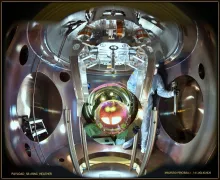
Virgo detector has a cavity that allows to tune the response of the detector | The installation of the SR Mirror has been accomplished successfully and perfectly on schedule. |
|
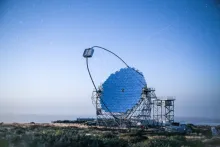
Le Télescope LST-1 de CTA détecte une émission à très haute énergie provenant du Pulsar du Crabe | La Palma, Îles Canaries, Espagne - Entre janvier et février 2020, le prototype de télescope de grande taille (LST), le LST-1 récemment mis en service sur le site CTA-Nord sur l'île de La Palma dans les îles Canaries, a observé le pulsar du Crabe au centre de la nébuleuse du même nom. |
|
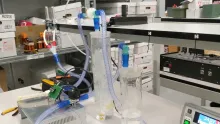
Physicists create newly designed medical ventilator | In response to the COVID-19 pandemic and the resulting shortage of ventilators, the DarkSide collaboration develops a new model of easily produced and low-cost mechanical ventilators. A prototype has already been made and is now being tested in an Italian hospital.
|

|
greetings card 2020 | |
|
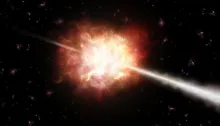
First detection of gamma-ray burst afterglow in very-high-energy gamma light | Press release |
|
General Assembly of the GdR Gravitational Waves | APC researchers participate in seminars in Lyon. |
|
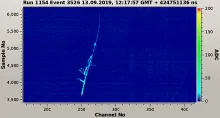
ProtoDUNE Dual Phase | DUNE press release highlighting the first tracks seen with the Dual Phase prototype. The DUNE group at APC participate in this. |
|
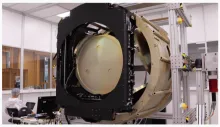
The filter changer of the LSST telescope | On October 4, 2019, the LSST camera's filter changer flew to San Francisco. Read more... |
|
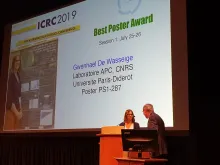
Best poster award for Gwenhaël de Wasseige | Last July, some of our researchers were at University of Wisconsin-Madison for the 36th International Cosmic Ray Conference. |

|
IGOSat in Research | IGOSat was honored by an article in the double issue (July-August) of La Recherche, currently on newsstands, dedicated to hazards. |
| KM3NeT has a new Technical Project Manager! |
Congratulations to Miles Lindsey Clark upon his election |
|

|
Meet Hélène Langevin-Joliot | APC is honored to welcome Madame Hélène Langevin-Joliot on Thursday 11 october 2018 at 12h30 in the meeting room Luc Valentin (454A) |
|
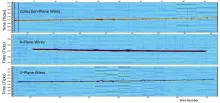
ProtoDUNE : First particle tracks seen | The largest liquid-argon neutrino detector in the world has just recorded its first particle tracks, signaling the start of a new chapter in the story of the international Deep Underground Neutrino Experiment (DUNE). Read the full article from Fermilab DUNE team at APC |
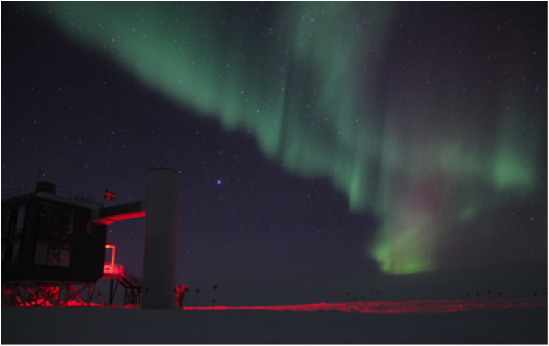
| Follow-up of the IceCube neutrino source candidate TXS 0506-056 |
The ANTARES and HESS collaborations have followed-up the IceCube observation of a first possible high-energy neutrino source candidate, and the APC groups have had a strong role in these searches.
|
|
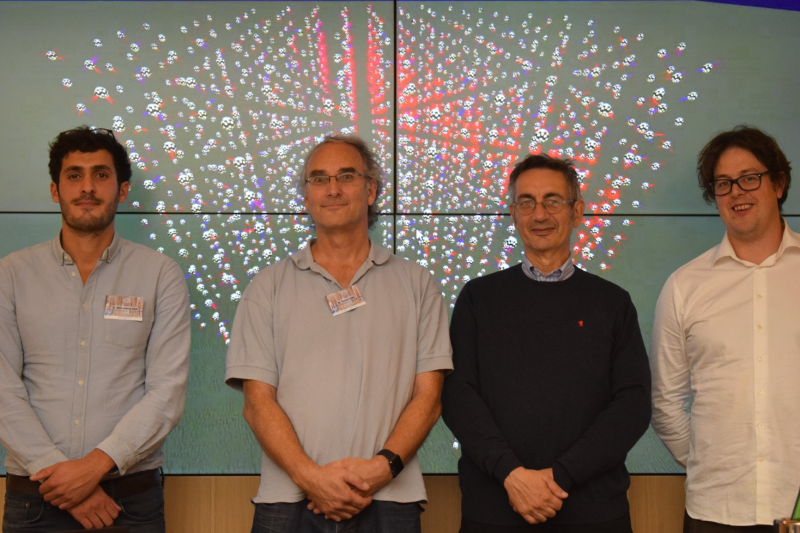
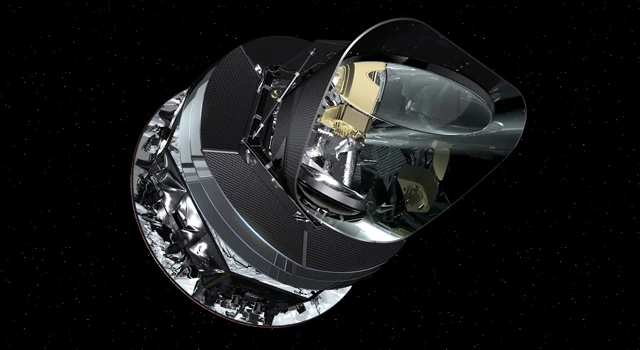
| Planck Collaboration Wins 2018 Gruber Cosmology Prize |
The Gruber foundation price in Cosmology has been awarded to the Planck team and the two PIs Nazzareno Mandolesi and Jean-Loup Puget. |