Functional Overview
ECLAIRs Pipeline (ECPI) will treat ECLAIRs data from the level L1 (SP1 for the Core Program) provided by the PP pipeline to level L3 (SP3 for the Core Program) producing the primary and secondary SDP listed in AD5 and annexe B. It is composed by a set of components that will be run sequentially or in loops to be defined. It shall be possible to launch the entire pipeline both in automatic and interactive way. It shall also be possible to run the pipeline starting from any given component and stopping at the end of any other given component provided that the input data and required parameters of the first one are available and that the last component follows the first in the sequence. The decomposition of the pipeline is presented in Fig 1.
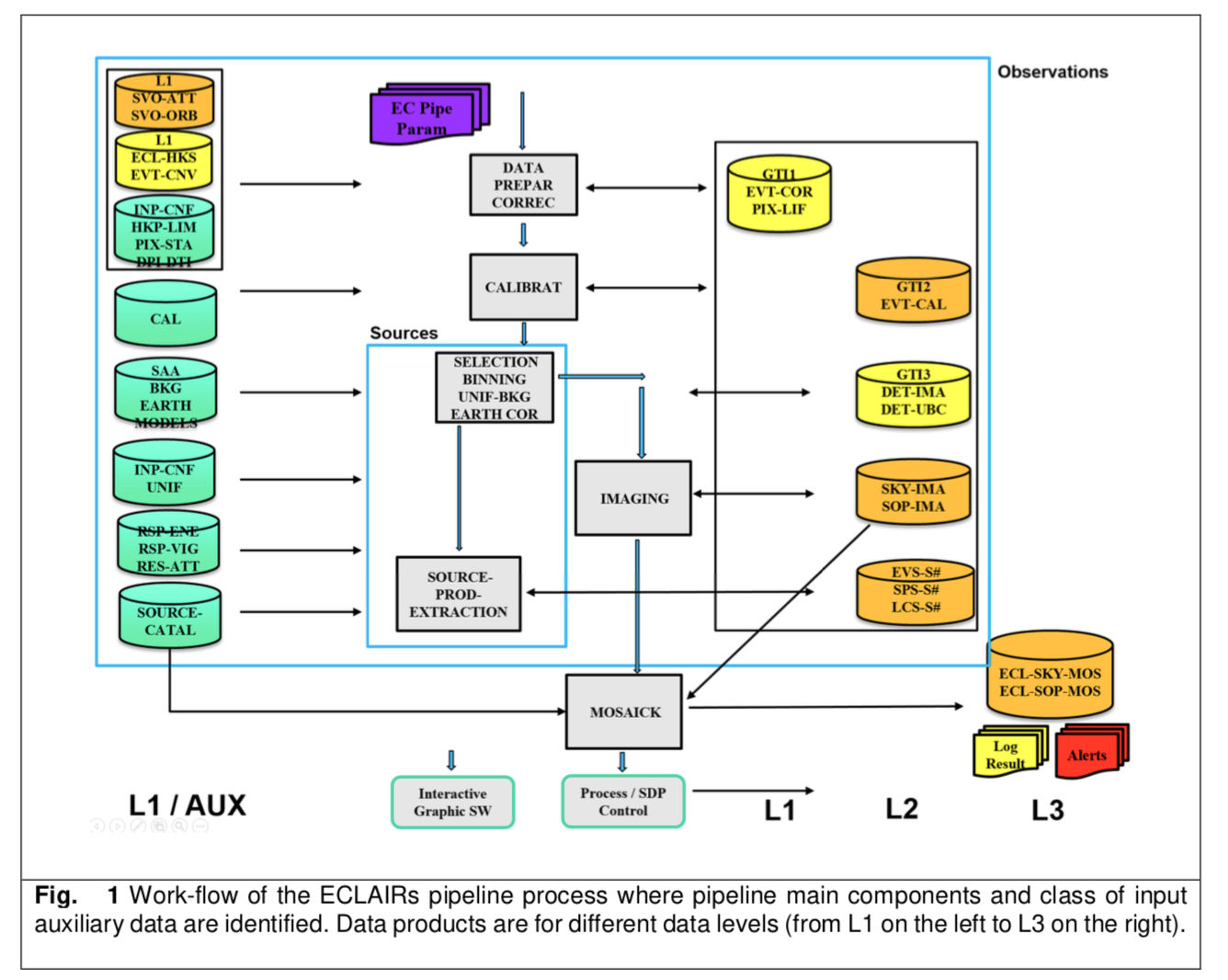
Pipeline decomposition
ECLAIRs Pipeline (ECPI) is composed by 6 large components plus a set of tools for the interactive analysis. Table 1 identifies them and indicates main responsibility for development within the teams of the FSC.
Table ECPI Components
PIPELINE COMPONENTS |
Acronym |
Responsibility |
|---|---|---|
Data Preparation and Correction |
DPCO |
APC+IRAP |
Calibration |
CALI |
APC+IRAP |
Selection, Binning, Uniformity, Background & Earth Correction |
BUBE |
APC+CEA |
Imaging and Source Detection |
IMAG |
APC+CEA |
Source Product Extraction |
SPEX |
APC+CEA+IRAP |
Mosaicking |
MOSA |
APC+CEA |
Interactive SW |
ECIS |
APC |
Decomposition of the components in modules and functions is under definition and will be reported in the detailed Architectural Design Document (ADD) of the ECLAIRs Pipeline (R4).
Data Preparation and Correction
This component shall perform the following tasks:
Analyze relevant Satellite HK data, attitude and orbit parameters in order to define GTI for good observation conditions for ECLAIRs data (e.g. stable attitude, out of SAA, low Earth occultation, high solar angle, low solar and background activity, etc.).
Analyze EC HK and EC raw science event data in order to restrict the GTI to periods of good instrument functioning.
Use EC HK and EC SE along with tables of pixel status and pixel thresholds (Auxiliary data) to compute dead-times and evaluate for each pixel an effective pixel lifetime possibly dependent on time and on energy.
Flag, filter or correct, if possible at this stage, the ECLAIRs raw events with respect to the computed GTI and pixel lifetimes.
Energy Calibration
This component shall perform the following tasks:
Analyze data in order to update the gain and offset calibration values to the present observation if needed.
Apply the gain and offset to each event in order to associate to it an energy in keV. The event energy value (or energy channel) shall be compatible with the energies defined in the associated ECLAIRs energy response.
Selection and Binning, Uniformity and Background correction, Earth Occultation Correction
This component shall perform the following tasks:
Select the calibrated events based on scientific input parameters for this component.
Bin the selected calibrated events in detector images, for a set of given energy ranges and within a set of time intervals.
Create and associate the proper efficiency detector images based on the pixel life-time information.
Prepare uniformity and background images based on the same selection/binning parameters of the detector images.
Apply a non-uniformity correction and a background model subtraction to the binned detector images. The background model shall include the CXB contribution, the particle induced background and the Earth albedo contribution.
Apply a “correction” for the Earth Occultation effect in order to take into account the partial and variable occultation of the ECLAIRs field of view by the Earth. The earth passage in the FOV shall be included in the computation of the background model.
Possibly take in account (by modelling) bright source contribution at this stage (TBD). In this case input catalogue will be needed (not mentioned in the input section).
Imaging and Source detection
This component shall perform the following tasks:
Reconstruct sky images from the ECLAIRs uniformity-background-earth corrected detector images over the entire FOV of the ECLAIRs telescope. Each of them shall include intensity, variance, signal to noise, exposure and source model images.
Detect, locate and identify from a master catalogue the point sources contributing to the sky image.
Clean the coding noise of each detected source from the reconstructed sky image in order to search for weaker objects.
The set of parameters derived in this process for the detected (or searched) sources shall be given in output. Parameters shall include at least: the identifier of the source, the name of the possible identification, the fluxes with associated errors and signal to noise in given energy bands, the position in image and celestial coordinates with associated errors, other TBD parameters.
Detection of a new, unknown source shall generate a clear alert message in output.
Source product extraction
This component shall perform the following tasks:
Extract for each requested point source a spectrum in given energy bins and for a given time interval, normalized to the on axis value. The count spectrum shall be associated to a proper energy response that allows a fitting procedure to be implemented.
Extract for each requested source a number of light curves with predefined time bins and in predetermined energy ranges.
Extract for each requested point source an event list where the illumination fraction by the mask for that source is indicated and with the arrival time corrected to the solar system barycenter.
Sky image Mosaicking
This component shall perform the following tasks:
Combine a given set of reconstructed and cleaned sky images in a sky image mosaic using a predefined sky projection (tangential, aitoff, etc.).
Search for significant excesses in the sky image mosaic, correlate with the master catalogue and report source parameters obtained by this analysis.
Interactive software for graphic display, combination of products and analysis
Software tools shall be available to allow a scientist to operate:
Graphic visualization of reconstructed and mosaic sky images with source position display. As a minimum the generated data products shall be compatible with ds9 image display or similar packages.
Graphic visualization of spectra and light curves and their analysis. As a minimum the generated data products shall be compatible with XSPEC and XCRONOS or similar packages.
TBD more specific manipulation of the data products that take into account the coded mask nature of ECLAIRs data and results (sum/combination of data products).
Transmission of report and alerts to the SVOM PIs and community. Possibly initiate writing of alert/telegram to the astronomical community when decision of distribution is taken at SVOM level (as defined in AD2).
R |
Title - Authors |
Reference |
Date |
|
|---|---|---|---|---|
1 |
ECLAIRs data analyses - Gros A. et al. |
SvomSol—000321 |
0.2 |
03/11 |
2 |
Eclair’s : Geometry, Deconvolution and PSLE - Gros A. |
ECL-RP-I-047546 |
1.5 |
|
3 |
SVOM Coordinate Systems and Conventions Document (CNES-CSCD) |
SV-SY-NT-242-JPO |
04/ |
29/09/17 |
4 |
GP ECLAIRs FITS Keywords |
ECL-GP-FITS-KX |
1.0 |
02/19 |